Project
Larsen Jewellery
A large, working website for a Sydney and Melbourne jeweller that had become unsafe to change
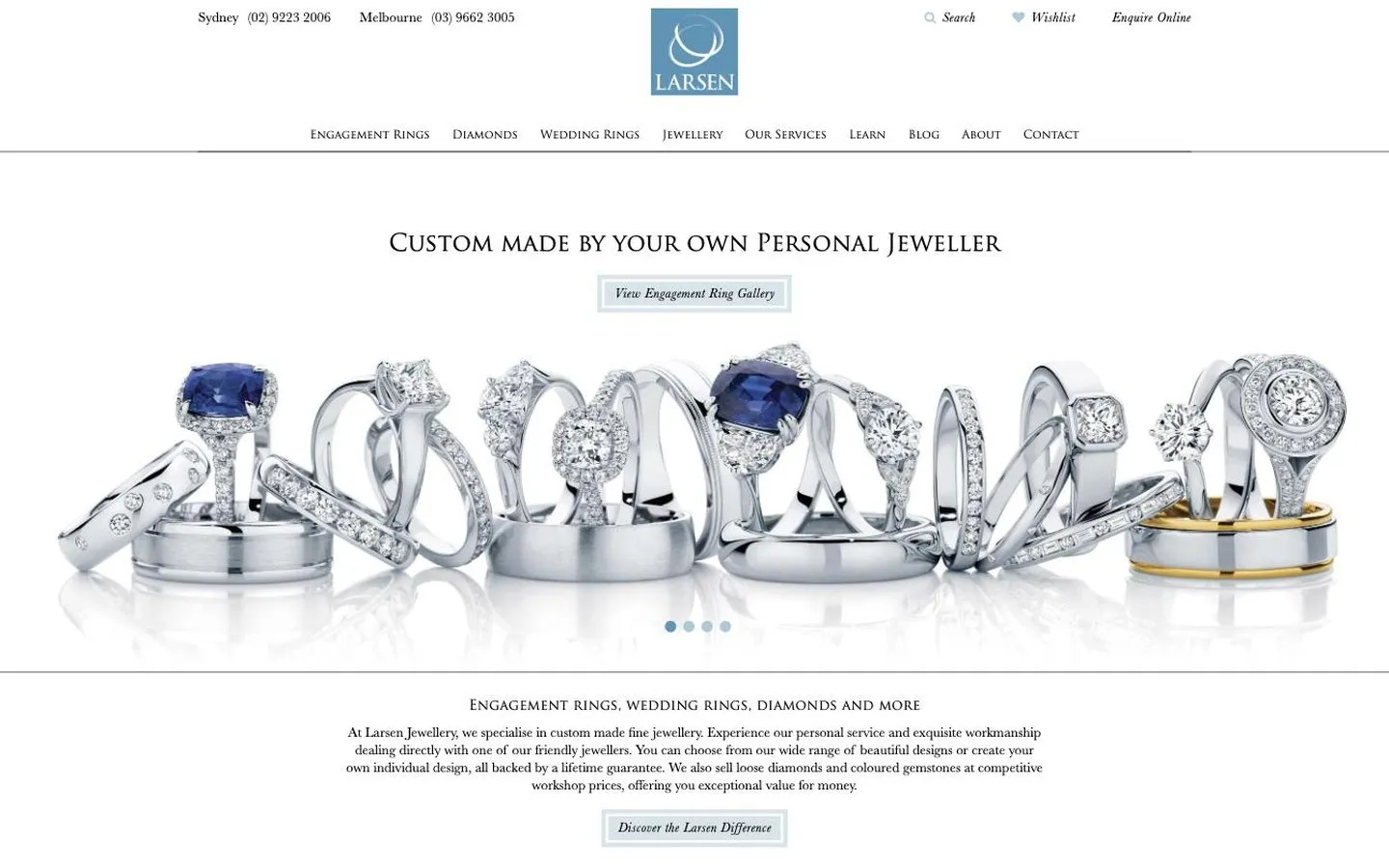
Larsen Jewellery makes fine jewellery to order from showrooms in Sydney and Melbourne, working with customers directly and making every piece to order rather than selling it off the shelf. Engagement rings and wedding rings, custom made and backed by a lifetime guarantee, plus loose diamonds and coloured gemstones sold direct. Their website was correspondingly large: pages and pages of rings organised by shape, design, metal and stone, a wishlist customers built as they browsed, and an appointment request form to get them into a showroom.
The screens on this page are the site as it ran in 2016, around the time of this work. It has since been replaced, so what you see here is that site, not the current one.
Project Scope
- Taking on a site built by somebody else
- Rebuilding it to work the normal way underneath
- Every ring page and customer tool kept working
- No visible change for customers
- A site that could be maintained again
The challenge
There was nothing wrong with the website that a customer could see. It looked right, it worked, and its whole job was getting people into two showrooms. The problem was that it had been put together in a way that did not follow any of the normal conventions, so it could not safely be changed. Ask for something small and the answer was that nobody was sure what it would break.
That is a slow emergency rather than a fast one. The business stops asking for changes because changes are painful, the site quietly falls behind, and eventually the only advice anybody will give is to throw it away and start again. For a site with this much on it, a full catalogue of ring pages people already relied on, starting again would have been far more work than fixing what was there.
What I did
I rebuilt the parts of the site customers never see, so it worked the way websites normally work, and left everything customers do see exactly as it was. The test of a job like this is that nobody visiting the site could tell it had happened.
A site anyone could work on again
Larsen's site was rebuilt underneath so that it worked the way other websites work. That meant any competent web person could pick it up and change it safely, instead of only somebody who had learned its quirks.
A catalogue that survived intact
Engagement rings could be browsed by shape, by design, by metal or by stone, and every one of those routes had to keep working. Nine ring shapes, five design styles, four metals and three gemstones, and every one of those still took the customer to the same place afterwards.
The wishlist kept working
Customers saved rings to a wishlist as they browsed and could email it to somebody else, which for an engagement ring is the entire point. It had to still work exactly as before when I was finished, and it did.
Appointments still reaching a jeweller
The site existed to get people into a showroom, so the appointment request was the one thing that absolutely could not break. It kept asking which state the customer was in, and the enquiries kept arriving.
Across the site
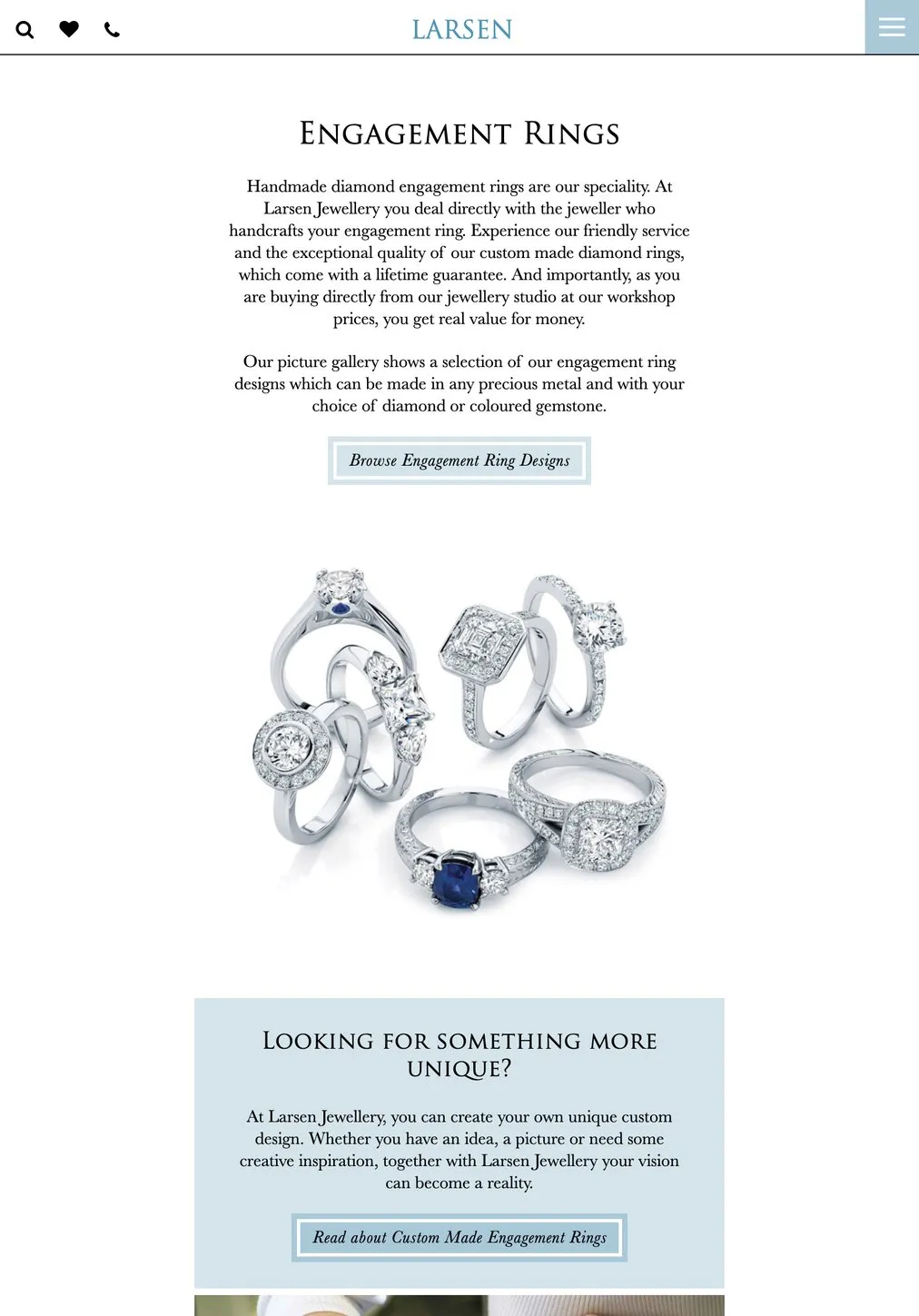
Engagement rings, the largest section of the site
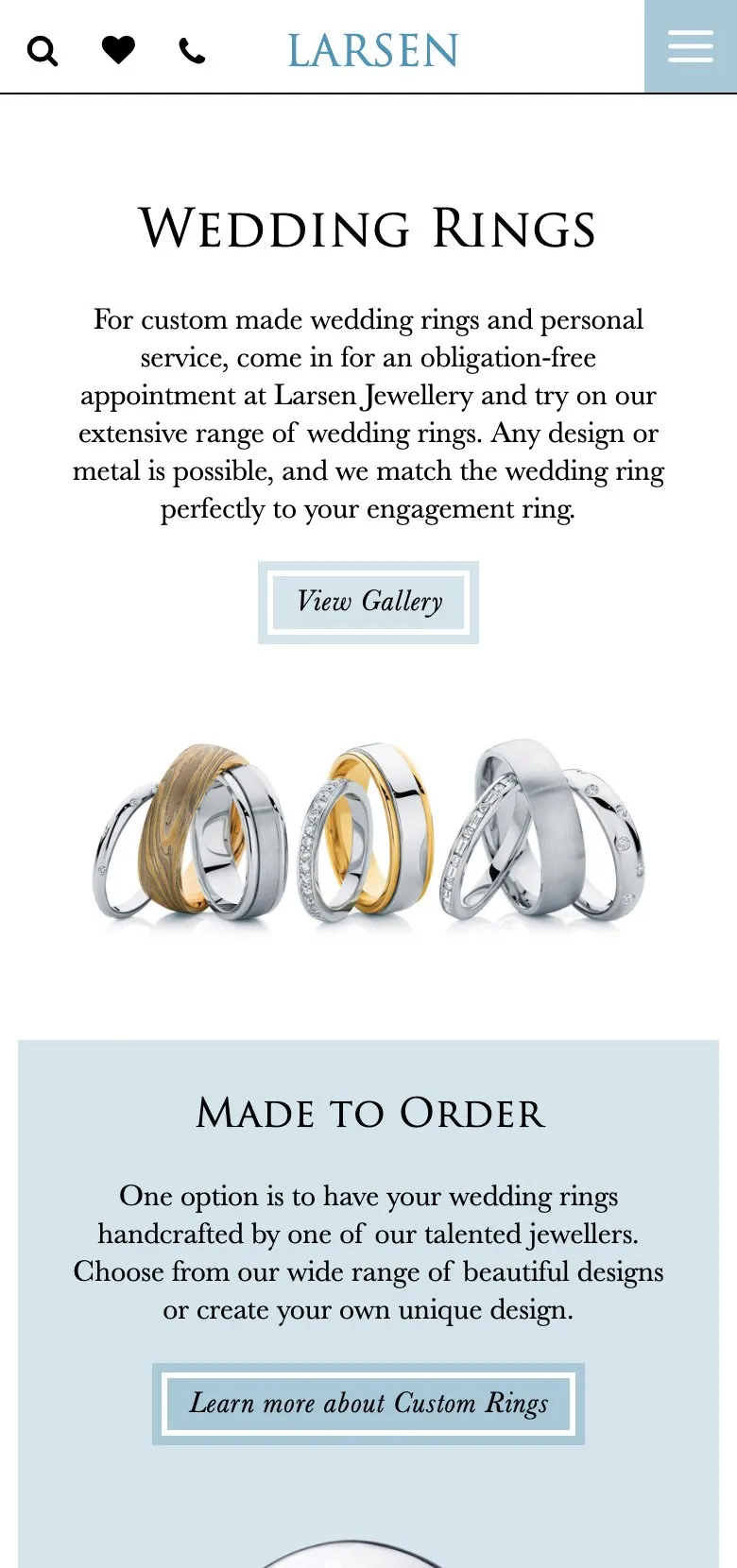
Wedding rings, on a phone
The result
Larsen came out of it with the same website and a completely different future. Nothing customers touched had moved, and the business could ask for changes again without the answer being a shrug. A site that had been drifting towards a full replacement went back to being an asset that could be improved a piece at a time.
This is the least visible sort of work there is, and it is often the most valuable. A website full of pages people already find is worth a great deal, and throwing it away to escape a maintenance problem trades a real asset for a fresh start nobody asked for.
If you have inherited a website that everyone is frightened of, that is worth a conversation before anybody suggests a rebuild. See how I approach taking on an existing site, read the MDT DESIGN and Nick Ireland jewellery projects, or get in touch.
Common questions about this project
It means the site works, but nobody can safely change it. It was built in an unusual way rather than the standard way, so the normal ways of working on a website do not apply to it. Every small request turns into an investigation, and every change carries a risk of breaking something unrelated.
No, and that was deliberate. Nothing a customer saw changed. The whole point of the job was that the site kept doing exactly what it was already doing, while becoming something that could be worked on again.
It depends what is under it. A big site with a real catalogue, a long history and a lot of pages behind it is worth rescuing, because a rebuild puts all of that at risk. A small site with little behind it is usually cheaper to replace. Larsen was firmly in the first category.
Regularly. It is a large part of what I do. Sites built by somebody else always carry decisions nobody wrote down, so the first thing I do is find out what is really there. After that the site can be brought back to normal and looked after like any other.
Yes, and often. Jewellery is one of the trades I keep coming back to, and it is unusually demanding online: the same ring exists in several metals, shapes and stones, and a customer expects to browse by any of them. Getting that right is the difference between a catalogue people enjoy and one they abandon.